

At 38, I Found Myself Unemployable
I had the résumé, the experience, three career coaches, and more than 200 applications. I still couldn’t get hired.

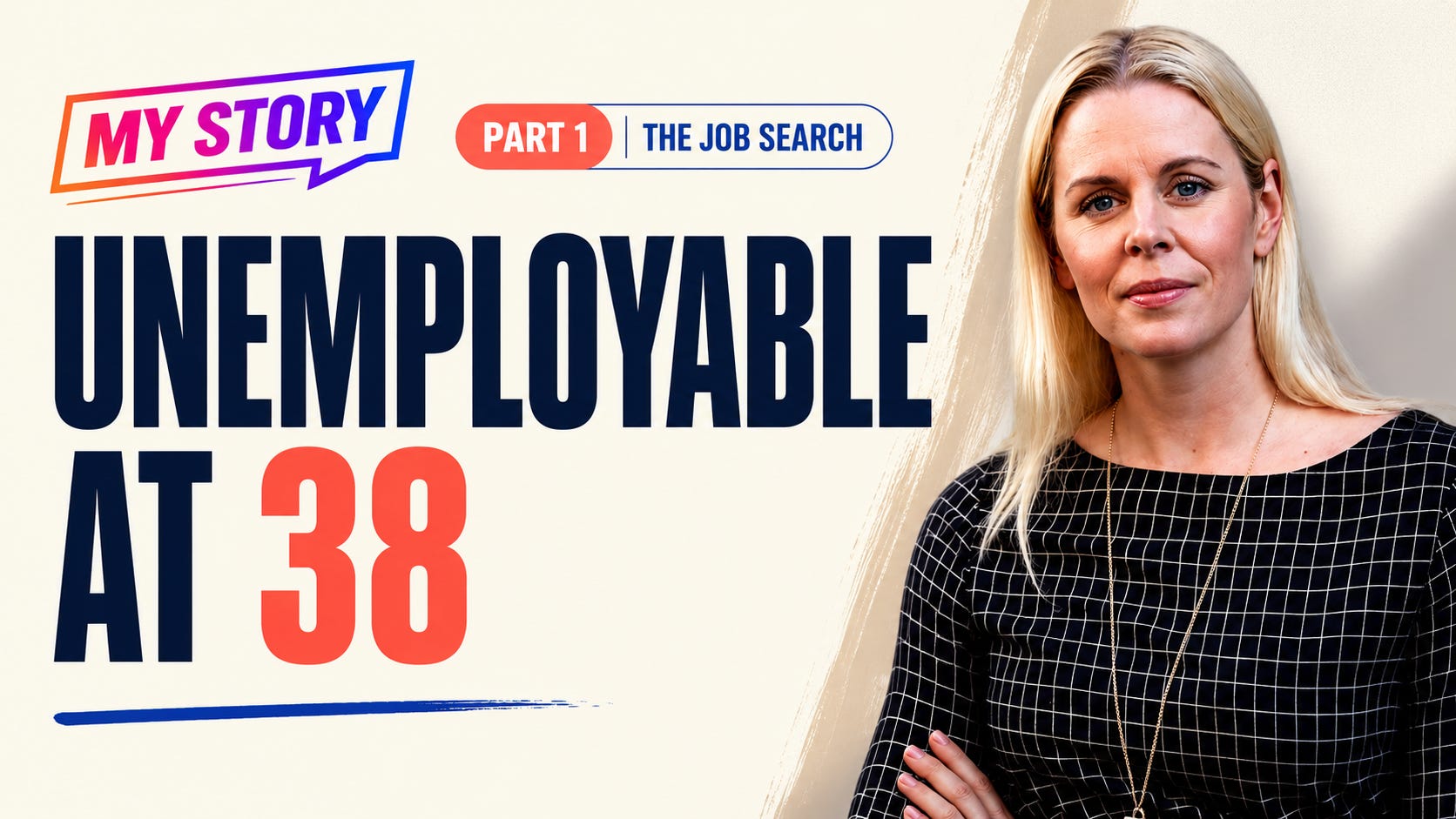
At 38, the idea that I might be unemployable felt surreal.
Thirty-eight is supposed to be a pretty good age professionally. In fact, when this happened to me in 2018, women between 35 and 54 were in the highest-earning age groups in the U.S.
That makes sense. By then, you’ve had enough time to build real experience, make mistakes, develop judgment, lead people, manage difficult situations, and actually know what you’re doing. I had always assumed experience worked a little like compound interest: the more of it you accumulated, the more valuable you became.
At 38, I thought I should be entering some of the strongest earning years of my career. Instead, I was struggling to get hired.
Before everything fell apart
A few years earlier, I thought I had done everything right.
By my early 30s, I had what I considered the good life. I was married, raising kids who went to private school, living in a nice house in a city I loved, and financially comfortable enough that travel or the occasional splurge didn’t require a major calculation. We weren’t living some billionaire Silicon Valley fantasy, but we were comfortable.
Professionally, I was doing work I was proud of. I was CMO and co-owner of a thriving agency that had grown into an eight-figure business. I had a title, a company, clients, colleagues, and a professional identity that felt established.
I had been working since I was 20, including through three pregnancies, and work had always been fulfilling to me. I had built a career, a business, a family, and financial stability. I remember looking at my life sometime in my 30s and thinking, more or less, I did it.
That didn’t mean I was finished or that I wasn’t ambitious. I was always thinking about what came next. But I believed the foundation underneath my life was solid.
That’s important because I wasn’t bored with my career or looking for an excuse to blow up my life in pursuit of some romantic idea of freedom. The life I had carefully built simply stopped being the life I could count on.
Before Everything Fell Apart
A few years earlier, I thought I had done everything right.
By my early 30s, I had what I considered the good life. I was married, raising kids who went to private school, living in a nice house in a city I loved, and financially comfortable enough that travel or the occasional splurge didn’t require a major calculation. We weren’t living some billionaire Silicon Valley fantasy, but we were comfortable.
Professionally, I was doing work I was proud of. I was CMO and co-owner of a thriving agency that had grown into an eight-figure business. I had a title, a company, clients, colleagues, and a professional identity that felt established.
I had been working since I was 20, including through three pregnancies, and work had always been fulfilling to me. I had built a career, a business, a family, and financial stability. I remember looking at my life sometime in my 30s and thinking, more or less, I did it.
That didn’t mean I was finished or that I wasn’t ambitious. I was always thinking about what came next. But I believed the foundation underneath my life was solid.

Then Everything Changed
At 38, that foundation disappeared.
I got divorced, sold my shares in the agency, and liquidated assets. Within a relatively short period, the household, career, and financial structure I had spent years building had fundamentally changed.
This wasn’t some deliberate midlife reinvention. I wasn’t bored with my career or chasing a romantic idea of freedom. I was trying to figure out how to rebuild a life that, not long before, I thought was secure.
I wasn’t asking myself an exciting question like, What do I want to do next? I was trying to answer a much more practical one: How am I going to support the life and family I already have?
Given everything going on, full-time employment seemed like the obvious answer. What I didn’t know yet was that the career security I thought I had accumulated didn’t work quite the way I assumed it would.
So I Did the Responsible Thing
San Francisco is an expensive place to start over, especially while going through a divorce and trying to create two separate households for your kids. For much of that period, I was staying in Airbnbs while trying to secure a long-term rental, and the costs kept piling up: housing, school, food, activities, transportation, and enormous legal fees.
Moving somewhere significantly cheaper wasn’t really an option because we shared custody and I needed to stay close to my ex and the kids’ schools. For context, San Francisco was already the second-most expensive rental market in the country in 2018, with the average apartment renting for about $3,600 a month. I wasn’t exactly looking for a one-bedroom, either. I needed enough space for my kids.
I actually tried moving about 15 kilometers south for a while to reduce my housing costs. It made perfect sense on paper, but the extra commuting was hard on the kids, who were already dealing with enough change from the divorce. Eventually, I moved back close to their dad. I didn’t want my financial problems to become another disruption they had to absorb.
During mediation, I remember going through our monthly expenses for the kids. The mediator studied the numbers, went quiet for a moment, and finally said, “You guys spend way too much money on your kids.”
She wasn’t wrong. I just hadn’t yet accepted how much our financial reality had changed.
When we were together, I thought we earned more than enough to support the life we had built. I didn’t pay that much attention to what everything cost because we could afford it. Divorce changed that calculation very quickly. Now there were two households instead of one, huge legal expenses, new housing costs, and no predictable income coming in on my side.
I could literally watch the money leaving my account. More than anything, I was worried about making sure my kids had what they needed without destroying my own financial future in the process.
The truth is, full-time employment wasn’t what I really wanted. If my circumstances had been different, I probably would have gone straight back into entrepreneurship. I had loved the independence of owning the agency, and deep down I knew I wanted to build something of my own again.
But I also knew exactly how long it could take for a new business to produce reliable income. I had already lived through the early agency years when we barely made anything and had to work incredibly hard to get it off the ground. With kids to support, high expenses, and a shrinking financial runway, I didn’t feel like I had the luxury of doing that again.
So I made a deal with myself. I would get a full-time job for maybe five years, pay for my kids’ school, rebuild my finances, and get back on my feet. In the meantime, I could start something small on the side and gradually build my way back into entrepreneurship.
For this season of my life, I thought I needed to do the responsible thing rather than the thing I actually wanted. And with my experience, I assumed finding a good full-time job would be the easy part.
I Hired Three Career Coaches
Once I decided to pursue full-time employment, I took the job search seriously. Over the next two years, I hired three different career coaches: one to help with my résumé and overall search strategy, a former recruiter who specialized in LinkedIn and applications, and another former recruiter who coached me specifically on interviewing.
My finances were already under enormous pressure while I was paying for all of this, but I saw it as an investment in my future. If professional help could shorten the search and get me into a solid full-time role, it felt worth it.
I rewrote my résumé, got new professional headshots, overhauled my LinkedIn profile, and started posting regularly. At the time, I had no intention of becoming a creator or building an audience. LinkedIn was simply part of my strategy to get hired.
The search itself quickly became a second job. By then I had a full-time contract role, so most of my job hunting happened after hours. I would put the kids to bed, sit down at my computer, and spend the evening researching companies, tailoring applications, writing cover letters, following up with recruiters, preparing for interviews, and tracking everything in a spreadsheet.
I was also active on LinkedIn every day, commenting, posting, reaching out to people inside companies, and setting up informational conversations. I joined one of the largest tech job-seeker communities in the Bay Area and started attending events. I met people for coffee, spoke with recruiters, worked with my coaches, and went to networking events whenever I could.
Over two years, I submitted more than 200 applications. I gave the search everything I had.
One thing nobody really tells you about seriously looking for work is how much unpaid labor it requires before anyone pays you a dollar. In my case, I was fitting that labor around a contract job and a family.
Community Matters When You’re Job Hunting
A long job search can become incredibly isolating. You spend hours behind a computer applying, following up, getting ghosted, and trying not to turn every rejection into a judgment about your worth.
I made a point of getting out of the house and around other people. Through the Bay Area tech community, I became involved with LinkedIn Local, a grassroots movement where people organized free in-person meetups with people they had connected with on LinkedIn. I eventually started helping host the San Francisco events every couple of months.
I also started volunteering what I knew. Through career organizations, I gave free talks to people trying to break into product marketing. As I learned more about LinkedIn and started growing my own following, people began asking how I was doing it, so I started teaching that too.
None of this got me hired, but it gave me community and a way to keep contributing at a time when rejection was constantly testing my confidence. Helping other people reminded me that I still had something valuable to offer.
I Was Working, But Still Falling Behind
Early in the search, a placement agency found me a contract role that was genuinely interesting. It had a lot of responsibility and moving parts, and the work itself was a great fit for my product marketing background. I enjoyed the actual work, but morale was low and the environment was bleak. It reminded me how much I had valued the autonomy of owning a business.
My life outside work was exhausting too. I had a newborn at home and was still pumping milk while working. I had temporarily moved outside San Francisco to find a rental large enough for the family at a lower cost, which meant commuting back into the city while also trying to be present for my older kids during my custody time.
Most days felt like one long handoff from one responsibility to another: work, the commute, the kids, the baby, and then the job search after everyone was asleep. I was still pumping milk during that period, which tells you roughly how glamorous this particular chapter of my career was.
The contract brought in income, but it still wasn’t enough to cover my housing costs, legal bills, family expenses, and everything else that had changed after the divorce. My savings kept shrinking, and eventually I crossed the line from spending down savings to accumulating debt.
One of the hardest things for me to accept was that I wasn’t going to recreate the same life I had before the divorce, only in a separate household. Looking back, I was still trying to preserve some version of it. I furnished the kids’ rooms nicely and even took vacations we couldn’t really afford. Those weren’t smart financial decisions, but at the time I was struggling to accept just how much my circumstances had changed.
I Failed
After two years, I had to admit that the plan hadn’t worked.
There had been plenty of rejection and even more silence. Some applications disappeared without a response. I was told I was overqualified for certain roles. Other jobs paid far less than I needed to support my household, or required commutes that simply didn’t work with my life.
There was one opportunity I genuinely thought was going to work. The company flew me out for interviews, and my conversations with the person who would have been my manager and two future colleagues went extremely well.
Then I met my potential manager’s manager, and I could immediately feel something change. Maybe she already preferred another candidate. Maybe I simply wasn’t what she had in mind. I’ll never know, but I didn’t get the job.
That rejection hit hard because by then I had done almost everything I knew how to do. I had invested in professional help, applied to more than 200 jobs, networked constantly, learned LinkedIn, practiced interviewing, worked contract jobs, and kept trying to convince myself that the right opportunity was just around the corner.
Meanwhile, my finances were getting worse. The contract was taking up most of my time but still wasn’t paying my bills. Every month, more money was going out than coming in, and I was now actively going into debt.
The hardest part was feeling as though I was failing everywhere at once. I felt guilty that I wasn’t spending enough time with my newborn. I felt guilty about the long drives back and forth for my older kids. I felt guilty that after the divorce I couldn’t give them the same life and experiences I had been able to give them before.
By then, my life no longer felt like a temporary rough patch. I was working constantly, worrying constantly, and still falling further behind. The contract wasn’t covering my expenses, the job search wasn’t producing a job, and I had crossed the line from spending down savings to accumulating debt.
After two years of trying to make the responsible plan work, I finally had to admit that it wasn’t working.
I didn’t know exactly what I was going to do instead. I only knew I could no longer afford to keep doing more of the same.
Next week, I’ll tell you what happened when I stopped trying to rebuild the life I’d had and started figuring out what came next. So if this topic interests you, follow along.