

It started with a few whispers.
Substack.
I’d hear the name here and there, usually from writers, and I’ll admit I never paid much attention. My impression was that it was basically like Medium, a place for professional writers to write very writerly things for other writers.
Then I started hearing about it more often.
People I followed on LinkedIn would post something and say they’d written the full article on Substack. Writers I remembered from Medium were suddenly publishing there. Eventually curiosity got the better of me, so I wandered over to see what everyone was talking about.
That’s when I discovered something mildly ridiculous.
I already had a Substack account.
Since 2020.
Apparently Past Krista had arrived at the frontier years earlier, looked around, and quietly gone home without leaving Present Krista any useful instructions.
I no longer had access to the account, and Substack wasn’t able to help me recover it, so I started over. And because apparently I learned nothing from the first incident, I created two accounts this time for security.
Excellent start.
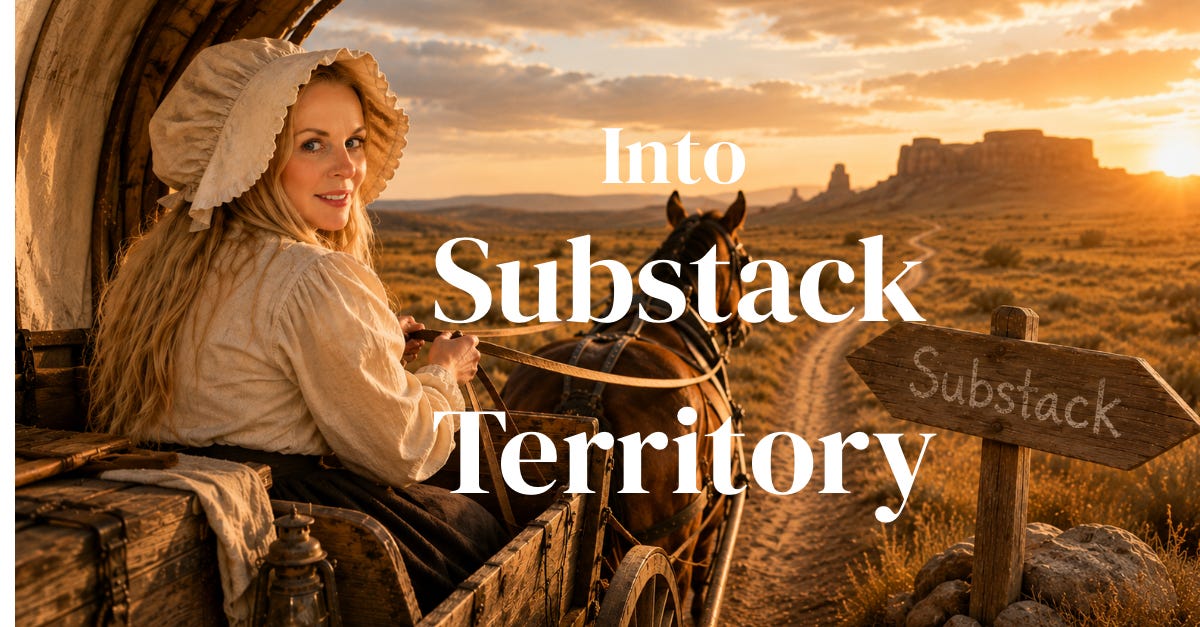
Then I entered the Wild West
I had no idea what I was looking at.
Notes. Publications. Restacks. Chats. Recommendations. Writers recommending writers. Notes that seemed to be doing extraordinarily well for reasons I couldn’t begin to explain.
And then there was my feed.
For reasons known only to the algorithm, Substack seemed convinced I was deeply interested in perimenopause, divorce, men behaving badly, and women with several cats rebuilding their lives.
To be fair, maybe the algorithm knows me better than I’d like to admit.
Professionally, though, I was confused.
I’m a marketer and entrepreneur who writes. I care about business models, money, positioning, work, creators, audiences, professional identity, and why smart people sometimes build businesses they eventually realize they don’t want.
So I figured I needed some help understanding this strange new land.
I joined a cohort run by a couple of genuinely lovely people who knew Substack well. Unfortunately, it also made something clear pretty quickly: I wasn’t really their target audience.
Most of the conversation revolved around becoming a full-time writer, growing through the writer community, recommending one another, commenting on each other’s work, and participating heavily in the Substack ecosystem.
There’s nothing wrong with that. It just wasn’t what I was trying to build.
Some of the growth advice also felt uncomfortably close to the engagement-pod and follow-for-follow behavior I’d spent years avoiding on LinkedIn.
So I finished the experience thinking I’d either have to figure Substack out my own way, or accept that maybe it wasn’t for me.
Naturally, I kept coming back.
Meanwhile, LinkedIn was testing my patience
LinkedIn has been incredibly good to me.
I’ve found clients there, built relationships around the world, grown a large audience, and had opportunities I never would have had otherwise.
I’m not leaving.
But by 2025, reach had dropped dramatically, the platform was changing, and I was becoming much more aware of something I had always known intellectually:
I could spend years building an audience there and still own none of it.
LinkedIn owns the platform. LinkedIn controls distribution. LinkedIn can change the rules whenever it wants.
At one point I was frustrated enough that I seriously considered walking away altogether, but abandoning an audience I had spent years building would have been ridiculous.
So instead, I started paying closer attention to what was happening elsewhere.
And Substack kept giving me reasons to look again.
Paid subscriptions.
Your own publication.
Chats and community features.
A direct relationship with readers.
And then I discovered the feature that really got my attention:
You can download your subscriber list.
You can leave.
That was huge for me.
After years of thinking about professional equity, audience ownership, platform dependence, and how much of our careers we build on land that belongs to someone else, Substack suddenly made more sense.
Maybe this wasn’t Medium 2.0 after all.
Maybe everyone really was loading up their wagons and heading west because somebody had heard there was gold out there.
So eventually, I packed mine too.
So where exactly is the gold?
For me, it starts with ownership.
I’ve spent years building an audience on LinkedIn, and I’m extremely grateful for it. But if LinkedIn disappeared tomorrow, I couldn’t exactly pack up my followers and take them with me.
On Substack, if someone subscribes to my publication, I have their email address. I can export the list. If one day I decide Substack has completely lost its mind, I can pack up the wagon again and leave.
That changes the relationship.
Then there’s the business model.
This was probably the biggest reason I started noticing so many writers migrating from Medium.
Medium has its own ecosystem and its own model for paying writers.
Substack makes it incredibly easy to create your own publication and charge readers directly.
No pitching an editor.
No submitting an article and waiting to see whether somebody wants it.
No asking permission to start.
You could wake up tomorrow, decide you’re now the proud publisher of The Weekly Potato, and have subscribers by lunchtime.
I find that kind of incredible.
And you don’t have to become a full-time paid newsletter writer for any of this to be useful.
I already have a business.
What interests me is having a place where my writing, audience, community, products, and business can actually connect.
That’s where Substack became much more interesting to me than simply “a place for writers.”
LinkedIn and Substack are useful for different reasons
I don’t really see one replacing the other.
LinkedIn is still incredibly good for discovery.
Someone who has never heard of me can come across one of my posts because somebody in their network commented on it. A CEO can find an article. A potential client can look at my profile and immediately understand my background.
And I can do the same with them.
That’s something I didn’t fully appreciate until I came to Substack.
On LinkedIn, I usually know who I’m talking to.
I can see that someone is a founder in London, a consultant in New York, or a marketing director in Singapore. I can see their work history, company, posts, and often whether we know some of the same people.
On Substack, sometimes I click a profile and get a first name, a tiny photo of a dog, and approximately zero additional information.
Who are you?
What do you do?
Are you a Nobel Prize-winning economist?
Are you twelve?
Do you even own that dog?
I have questions.
The anonymity also has a downside.
I’ve already come across things I would never expect to casually stumble across in my LinkedIn feed, including racist content, extremist propaganda, and explicit sexual material.
I’m perfectly capable of reading opinions I disagree with.
But there’s disagreement, and then there’s opening your feed over coffee and wondering how you accidentally wandered into a part of the internet you definitely weren’t looking for.
So no, I’m not declaring Substack the promised land.
The wagon has hit a few potholes.
And then there are Notes
I still don’t understand Notes.
I’ve spent years studying content and distribution. I understand LinkedIn pretty well. I can usually look at a post and make an educated guess about why it traveled.
Notes?
No idea.
I’ll see something like:
Sunday.
Apparently 4,000 people needed to hear that.
Meanwhile, I’ll publish something I spent actual time thinking about and Substack appears to show it to seven people and a squirrel.
Clearly I still have some frontier skills to acquire.
Oddly enough, I kind of enjoy that.
I’m new here.
I don’t have the platform figured out.
And after spending years being the person who supposedly understands LinkedIn, there’s something refreshing about being a beginner again.
What I’m actually here to write about
After eight years of entrepreneurship, 12 revenue streams, six pivots, a few spectacular mistakes, some things that worked far better than expected, and several moments when I wondered what on earth I was doing, I have plenty to talk about.
I’m interested in what happens after the shiny announcement.
What happens when the business you built stops fitting the life you want.
Why talented people can make good money and still feel trapped by what they created.
What happens when a title disappears.
How you turn experience into something you actually own.
How you build recognition without becoming an internet personality.
How you create multiple ways to earn without accidentally creating six different jobs for yourself.
And occasionally, why LinkedIn has 99 problems and somehow keeps finding another one.
I care much more about the messy middle than someone standing at the finish line explaining their perfect five-step formula.
Those formulas usually look a lot cleaner in hindsight.
Who I hope finds me here
Smart, experienced people who are questioning the traditional script.
Maybe you already have a business, but something about it no longer fits.
Maybe you have a great career and want to build something that belongs to you alongside it.
Maybe you’ve been laid off, burned out, retired, scaled back, changed industries, moved countries, raised children, started over, or simply reached the point where you’re asking:
Is this really how I want to spend the next ten years?
Those are the conversations I’m interested in.
I’m still building, experimenting, changing my mind, and occasionally driving the wagon into a ditch myself.
But I’m willing to talk about what happens between the success stories.
The pivots.
The bad bets.
The things I spent money on and regretted.
The things I nearly didn’t do that changed everything.
And the lessons you generally acquire only after paying for them in time, money, ego, or all three.
What you’ll get if you stick around
Free subscribers get my essays and observations on marketing, money, work, reinvention, business models, and the creator economy.
Paid subscribers get closer to what’s actually happening behind the scenes: breakdowns, numbers, experiments, decisions, what worked, what didn’t, and what I’m changing next.
After eight years, 12 revenue streams, and six pivots, I’ve accumulated a decent collection of scars.
I might as well make them useful.
So if you just discovered this publication, welcome.
Pull up a chair.
Or climb into the wagon.
Apparently we’re heading west.