

Should You Hire a Fractional Executive?
The smarter way to scale: why top founders are turning to part-time executives for full-time results


Thank you for reading my newsletter, Unignorable Brands, where I share my tips for small business owners and brands who want to go from feeling invisible online to being the go-to resource in their industry without losing their souls. If you want more, please consider subscribing on Substack or LinkedIn.
If you enjoyed this article, you will love our newsletter for solo creators and small business owners. I invite you to join 32,000+ subscribers here.
The Pain Every Founder Knows
You didn’t start your company to sit in endless meetings, fix broken processes, and chase projects that never quite land. You started it because you had a vision — something you wanted to build.
But somewhere between $1 million and $10 million in revenue, things start to shift.
You hit a wall.
Your marketing feels inconsistent. Operations are running on duct tape. You can’t find the right senior talent without blowing up payroll. And deep down, you know you’ve become the bottleneck.
You’re too big to wing it anymore, but not quite big enough to hire a full executive team.
That’s when smart founders are quietly turning to a new model of leadership: fractional executives.
Not consultants. Not agencies. Experienced leaders who join your company part-time to create clarity, direction, and systems that actually scale.
I. The Founder’s Dilemma
Every founder eventually faces this crossroads.
The hustle that got you here won’t get you there.
You’ve built something successful, but now growth has slowed. You spend your time putting out fires instead of thinking about strategy. The idea of hiring a $250K-a-year CMO or COO feels excessive, yet something has to change.
That’s when the question hits you: “Should I hire a fractional executive?”
Let’s walk through what that really means — and whether it’s the right move for your business.
II. Why Founders Are Turning to Fractional Leaders
Fractional leadership is gaining traction because the old model of building big, permanent teams doesn’t fit how companies operate today.
Budgets are leaner. Teams are remote. Founders need specialized expertise but not necessarily full-time headcount.
Fractional executives offer a new solution: senior-level leaders who work part-time with your company, helping you grow strategically without committing to a long-term salary.
Here’s why this works so well:
You get high-level strategy without the high six-figure overhead.
They move fast because they’ve seen your problems before.
They bring structure and systems where you currently have chaos.
They act as a bridge between your current stage and your next one.
Think of it like renting a Formula 1 driver to help tune and test your car before you hire a full-time team. You’re getting precision, speed, and confidence.
III. The Signs You’re Ready for a Fractional Executive
Here are a few signs you might be ready:
Growth has stalled. You’ve tried hiring agencies or freelancers, but nothing’s moving the needle.
You’re managing areas you don’t understand. Maybe it’s marketing, tech, or finance. You need someone who can lead confidently.
You can’t justify paying someone an executive salary yet. You need senior direction, but not forty hours a week of it.
You’re reacting instead of leading. Every day feels like putting out fires.
Your team is tactical, not strategic. Everyone’s busy, but there’s no clear vision connecting it all.
You’re in transition. Maybe you’re fundraising, merging, starting a new venture, or preparing for an exit. It’s the perfect time to bring in a fractional.
If several of these sound familiar, you’re probably at the inflection point where a fractional leader could make a huge difference.
IV. What You Actually Get When You Hire a Fractional
Here’s what a great fractional executive does:
Creates strategy that drives results. They look at your business holistically and define where to focus.
Builds systems that scale. Dashboards, reporting, processes, and team structures.
Coaches your team. They help your existing employees think like leaders.
Brings outside perspective. Sometimes you’re too close to see the patterns.
Prepares your company for the next stage. Whether that’s growth, hiring, or investment.
Consultants advise. Fractionals lead. They don’t just write reports — they build the engine.
V. The Real Costs (And Why They’re Not as High as You Think)
When founders first hear the word “fractional,” they often assume it’s expensive. The reality is that it’s far more affordable than hiring full-time executives.
Here’s a quick comparison:
A full-time CMO can cost $250K–$400K per year, plus bonuses and equity. A fractional CMO typically costs $8K–$20K per month, depending on scope.
That’s roughly a third of the cost — with zero overhead or HR risk.
But the real value isn’t just in saving money. It’s in the speed and clarity they bring.
They help you avoid bad hires, fix what’s broken, and unlock opportunities you didn’t see before. A good fractional pays for themselves in months, not years.
VI. The Mistakes Founders Make
Here are a few common pitfalls I see:
Treating them like consultants or VAs. Fractionals need access and authority. Their high-level expertise is wasted sitting in endless Zoom calls or $15/hr Admin tasks.
Hiring people “in transition.” You want someone who chooses this model intentionally, not because they’re between jobs.
Skipping onboarding. They can’t fix what they don’t understand. Give them context, data, and introductions.
Expecting instant magic. They’ll move fast, but they still need collaboration and clarity and depending on your needs, they’ll most likely need a team and budget to manage. Speed and results are only as good as the money and manpower you give them.
Expecting a solo superhero. A fractional is an executive, not an executor. They do not “do the job” of a full department. On the contrary, they build the department to get the job done.
No or vague success metrics. Always agree on what success looks like before you start and every quarter. “Getting results” is not something a true leader ever says. Fractionals operate best under mutually agreed upon written OKRs or KPIs with allocated budgets and teams, not lofty words like “Get new clients”. Success is only defined with written objectives and clear budgets, teams, and timelines.
Do those right, and the relationship becomes one of the most valuable in your business.
VII. How to Choose the Right Fractional Executive
When hiring, look for:
Experience building and leading teams, not just advising them. This is a very important distinction since many regular terminated employees are rebranding themselves as Fractionals without enough actual leadership experience.
Cross-functional understanding. You want someone who can connect sales, ops, and marketing. Ask about their prior work experience and look for someone who didn’t operate in an isolated silos.
Grit and go-getter attitude. In my personal experience, I prefer to hire Fractionals from scrappy start-ups or smaller businesses since they likely had to operate “lean” with less budget and more creativity to achieve KPIs.
Strong communication and chemistry. You should feel both challenged and supported. No leader needs a Fractional who is a ‘Yes’ man waiting to be told what to do. A good Fractional is a strategist who comes prepared to share ideas and discuss and who will often tell you ‘no’ because they understand their speciality better than you do. After all, that’s why you hired them.
A clear process. Ask how they handle hiring, onboarding, performance reporting, and budget management.
A long-term mindset. A good Fractional is all about building the future of the company with a strong department and assets that will run efficiently without them. They should be building systems that outlast them.
If you’re unsure, start small. Bring them in for a 30-day strategy sprint or audit. You’ll learn quickly whether they’re the right fit.
VIII. Fractional vs Consultant vs Interim Executive
Here’s how to think about it:
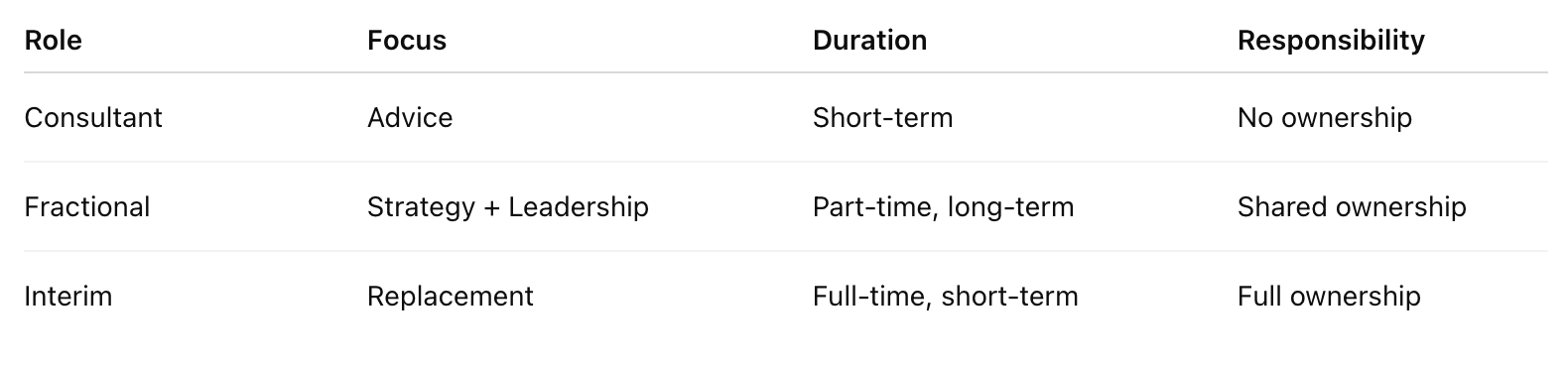
If you want someone to diagnose a problem, hire a consultant.
If you need someone to keep things running while you recruit, hire an interim.
If you want real transformation, hire a fractional.
IX. The Future of Leadership Is Fractional
We’re entering a new era of leadership.
Founders don’t want to build bloated teams anymore or executives cashing fat paychecks with little company success to show for it. They seek flexible, lean, and high-performing leadership that adapts to their company’s evolving needs.
Fractional work lets experienced executives do meaningful projects without corporate red tape, while founders get access to world-class expertise without high and long-term costs.
Small teams of part-time leaders run more and more, companies — fractional CMOs, CFOs, and COOs collaborating virtually to move faster than traditional org charts ever could.
This isn’t a trend. It’s the future of how great businesses grow.
X. Should You Hire One?
So, should you hire a fractional executive?
If you’re feeling stuck, stretched thin, or unsure what’s next in your business, whether it is Sales, Marketing, or Operations, probably yes.
Start with one. Test the waters with a 30-day audit or 90-day sprint. See what happens when someone experienced takes the reins on the areas that drain your time and energy.
Because growth doesn’t come from working harder. It comes from surrounding yourself with people who know how to unlock it.
Curious If It’s Right for You?
Are you a founder with a solid business background and some clients ready to scale and interested in working smarter instead of harder while saving money and getting higher-quality services? Then you may be a good candidate for a Fractional hire. I invite you to start with a Free AI Marketing Scorecard to see which areas you may need more help in. And if you are ready for marketing leadership, book a Fractional Strategy Call to explore how working with a part-time Fractional could give you full-time results.
Because sometimes, you don’t need more people. You just need better leadership.