

When You Should Not Hire a Fractional Executive
How to Know If the Fractional Model Is Right for You or If You’re Better Off with Another Solution


Thank you for reading my newsletter, Un-Ignorable Brands, where I share my tips for small business owners and brands who want to go from feeling invisible online to being the go-to resource in their industry without losing their souls. If you want more, please consider subscribing on LinkedIn or Substack.
If you enjoyed this article, you will love our newsletter for solo creators and small business owners. I invite you to join 32,000+ subscribers here.
The Hidden Truth About Fractional Leadership
Hiring a fractional executive sounds like the perfect solution.
You get senior-level leadership, years of experience, and high-level strategy without the overhead of a full-time salary. For many founders, it feels like a no-brainer.
But here’s the truth: fractional leadership isn’t for everyone.
In fact, hiring one too soon can slow your progress, confuse your team, and waste valuable resources.
Before you dive in, it’s important to step back and ask yourself whether this model actually fits your stage, structure, and goals. Because while it can be transformative for some companies, it can also be the wrong move for others.
Let’s take a closer look at how to know the difference and what to do instead if you’re not ready.
I. Get Clear on What You Really Need
When founders hit a wall, the instinct is to say:
“We need a full-time executive.”
But in most cases, what you actually need is clarity, structure, and systems, not a full-time hire.
A good fractional leader can set up frameworks that run almost 24/7, with minimal ongoing input. That means you may only need a few hours of their time each week to stay on track.
So before you hire anyone, ask yourself:
How many hours per week do we truly need senior-level leadership?
Do we need daily management or strategic direction?
Are we looking for someone to execute or to architect?
Here’s a rule of thumb:
If your company needs someone in meetings every day, juggling multiple managers, and putting out daily fires, meeting with clients and employees, you need a full-time executive.
But if your business primarily needs systems, direction, and a repeatable flywheel to follow, a fractional is often the better fit.
II. The Size and Complexity of Your Team Matter
The larger your team, the harder it is for a part-time executive to stay deeply integrated.
Here’s a simple benchmark:
If your marketing, sales, or ops team is under 10 people, a fractional can easily manage strategy and leadership remotely.
Once your team hits 10+ full-time employees, you’re likely better off with a full-time executive who’s embedded in daily operations.
Why? Because at that scale, your company needs constant alignment, in-person collaboration, and cultural leadership. Those things are tough to do part-time.
Location also plays a role.
If your team is remote and spread across time zones, fractional leadership works great. But if your entire team is in one office, you’ll probably benefit more from someone who can be physically present.
III. Your Financial Stage Will Tell You a Lot
Fractional roles are built for companies in the messy middle:
You’re past the scrappy startup stage but not yet ready for the full executive payroll burden.
Ask yourself:
What’s your current ARR (Annual Recurring Revenue)?
Can you confidently pay a full-time executive a high 6-figure salary for the next 12 months, plus perks and bonuses?
Are you ready and willing to take on the HR, legal, fiscal, and managerial burden of a full-time executive?
Are you in a growth phase, or still trying to find product-market fit?
If you’re still in early-stage growth mode or your cash flow fluctuates, a fractional is the smarter choice.
They give you access to senior talent while protecting your runway.
But if your company is already at steady multi-million ARR, with a clear direction and an established team structure, it may be time for a full-time executive who can fully own the role day in and day out.
IV. Define What You Expect Them to Own
A fractional works best when their role is strategic, not operational.
You’ll get the most value when you bring them in to:
✔️ Build a go-to-market strategy or marketing engine
✔️ Set up systems, dashboards, and processes
✔️ Coach and upskill your existing team
✔️ Guide you through a growth phase or transition
But if what you really need is:
✖️ Hands-on project management
✖️ Daily supervision of a large team
✖️ Heavy execution/production work
…then a full-time executive or internal director is a better fit.
Fractionals are leaders, not operators. They design the map, but your team has to drive the car.
V. Understand What “Part-Time” Really Means
One of the biggest misconceptions is that a fractional executive will be “on-call” like a full-time employee.
They won’t.
Nor should they.
Their value lies in their ability to step back, see patterns, and make high-level decisions, not to sit in back-to-back meetings all day.
If you hire one expecting 40 hours a week of attention, you’ll both end up frustrated.
Instead, think of them as a strategic partner, not a manager. They’ll bring perspective, direction, and frameworks that multiply your team’s impact.
VI. Compare Your Alternatives
Before you hire anyone, consider all the models available; each has its place.
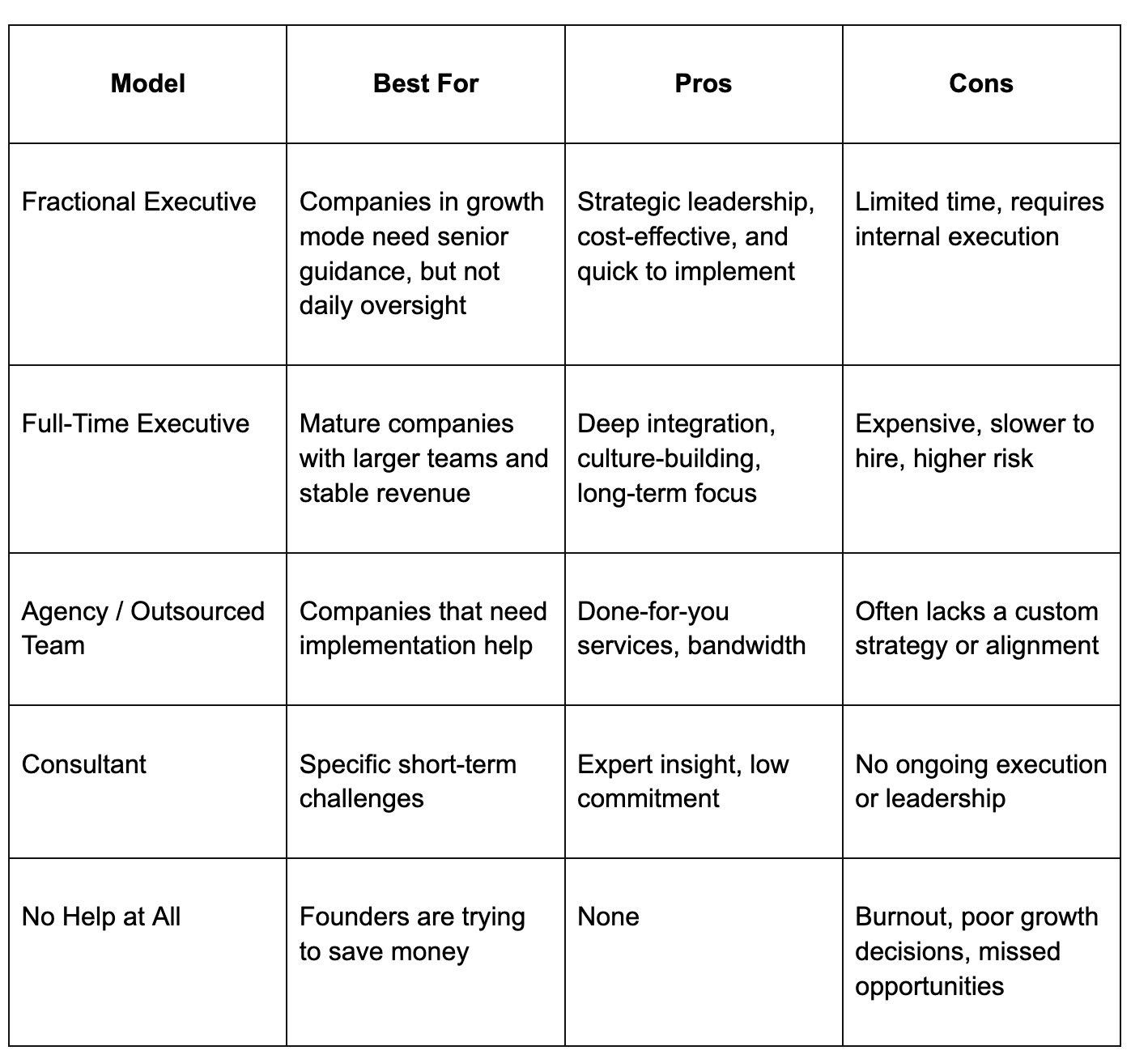
Please don’t choose the “no help” option.
Waiting until “you can afford it” is how many founders stay stuck.
If your systems aren’t in place now, your growth will always be limited. The sooner you bring in the right support — even fractionally — the faster you can grow into that full-time executive later.
VII. Common Situations Where a Fractional Doesn’t Work
Fractionals are amazing in the right context, but here’s when they typically fail:
You expect constant availability. If you want someone who lives in Slack and attends every meeting, hire full-time (or learn how not to micro-manage and to trust your hires more to work independently).
Your business lacks structure or direction. Fractionals need something to build on. If everything is chaos, start with a consultant or operations expert first.
You can’t delegate. Fractionals don’t replace founders — they empower them. If you struggle to trust others with big decisions, this model won’t work.
Your team needs heavy daily supervision. That’s a job for a director or manager, not a fractional C-level.
You’re under $1M ARR with limited bandwidth. You may benefit more from a marketing agency or part-time consultant at this stage.
VIII. When the Fractional Model Is Perfect
You’re ready to bring in a fractional when:
⚫ You’ve hit a growth ceiling and need pro advisory
⚫ You’re ready to invest in systems, not just quick fixes
⚫ You want mentorship for yourself or your internal team
⚫ You’re financially stable but cautious about overhead
⚫ You value experience and want someone who’s done it before
When those align, a fractional isn’t just a cost-saver; it’s a growth multiplier.
IX. The Right Mindset for Success
If you do hire a fractional, set it up for success:
Give them authority. Don’t treat them like a consultant. They need access, data, and trust.
Set clear deliverables. Agree on what “success” looks like in the first 90 days.
Pair them with strong internal operators and a hiring budget for team and tools. Their ideas need implementation muscle.
Think systems, not tasks. The goal isn’t to outsource work; it’s to build repeatable frameworks.
X. What to Do If You’re Not Ready Yet
If you realize after reading this that you’re not quite ready, that’s a win, not a failure.
Here’s how to move forward:
Hire a consultant to diagnose where your bottlenecks are.
Work with an agency to handle execution while you get strategic clarity.
Invest in internal training so your team can handle more ownership.
And above all, don’t fall into the “someday” trap.
“Someday, when we can afford a full-time CMO or COO, we’ll get serious about strategy.”
That’s the mindset that keeps businesses stuck.
Start building your systems now — even with limited resources — so that when the time comes, your executive (fractional or full-time) can scale what’s already working.
❓ Quick FAQs About Hiring a Fractional
How many hours per week does a fractional usually work?
Typically between 8 and 40 hours per month, depending on your company’s needs. The goal isn’t time — it’s results. They set direction and systems; your team executes.
Can a fractional manage a team?
Yes, but usually up to about 10–12 people. Beyond that, daily oversight and culture management often require a full-time leader.
How long do fractional engagements last?
Anywhere from 6 months to 3 years is typical. Some may also agree to convert to full-time for the right company to grow organically with you. In general, most fractional engagements start off with system-building and development and evolve into long-term partnerships for hiring, budgeting, scaling, mentorship, and stability as execution needs grow.
Is a fractional better than hiring an agency?
Different roles. Agencies execute; fractionals lead. A good fractional ensures your strategy stays aligned with your execution partners. Fractionals can help you hire the right agency and manage the work and budget.
What if I’m not sure I’m ready?
Start small. Even a short-term engagement or strategy sprint can bring clarity and structure — and help you grow into a longer-term partnership.
Want to educate yourself more about fractionals?
For a deeper dive into when a fractional executive is a fit, check out my companion piece: “Should You Hire a Fractional Executive?”
XI. The Bottom Line
Fractional executives are powerful assets in the right hands, at the right time.
They bring clarity, systems, and results without unnecessary overhead.
But hiring one too early, too broadly, or for the wrong reasons can do more harm than good.
So before you sign that contract, ask yourself:
“Do I need a leader to lead my team or do I need a system to run lean and smart operations without the overhead?”
Because when you know the answer, the right model becomes obvious.
XII. Let’s Talk About It
Every company reaches that crossroads: the point where you can’t do it all yourself anymore, but you’re unsure what kind of help you actually need.
So let’s make this practical:
If you’ve been thinking about hiring a fractional, or you’re wondering whether it’s too early, I’d love to hear your story.
What’s your biggest challenge right now when it comes to scaling your marketing or leadership?
Drop a comment or send me a message. I read and respond personally.
And if you’re a B2B founder who’s ready to scale smarter (without building a bloated marketing team), this is exactly what I help clients do.
As a Fractional CMO, I partner with founders to:
Build lean, AI-powered marketing systems that create predictable demand
Clarify your go-to-market strategy so you can grow faster with less noise
Align your brand, content, and sales ops under one growth engine
If that sounds like what your company needs next, let’s connect.
You can reach out to me directly via email, LinkedIn, or DMs to explore my fractional services or answer your questions about my fractional experience.
You don’t have to go full-time to go all in on your growth. The right fractional leader can give you an enterprise-level strategy without the enterprise overhead. That’s just smart business.